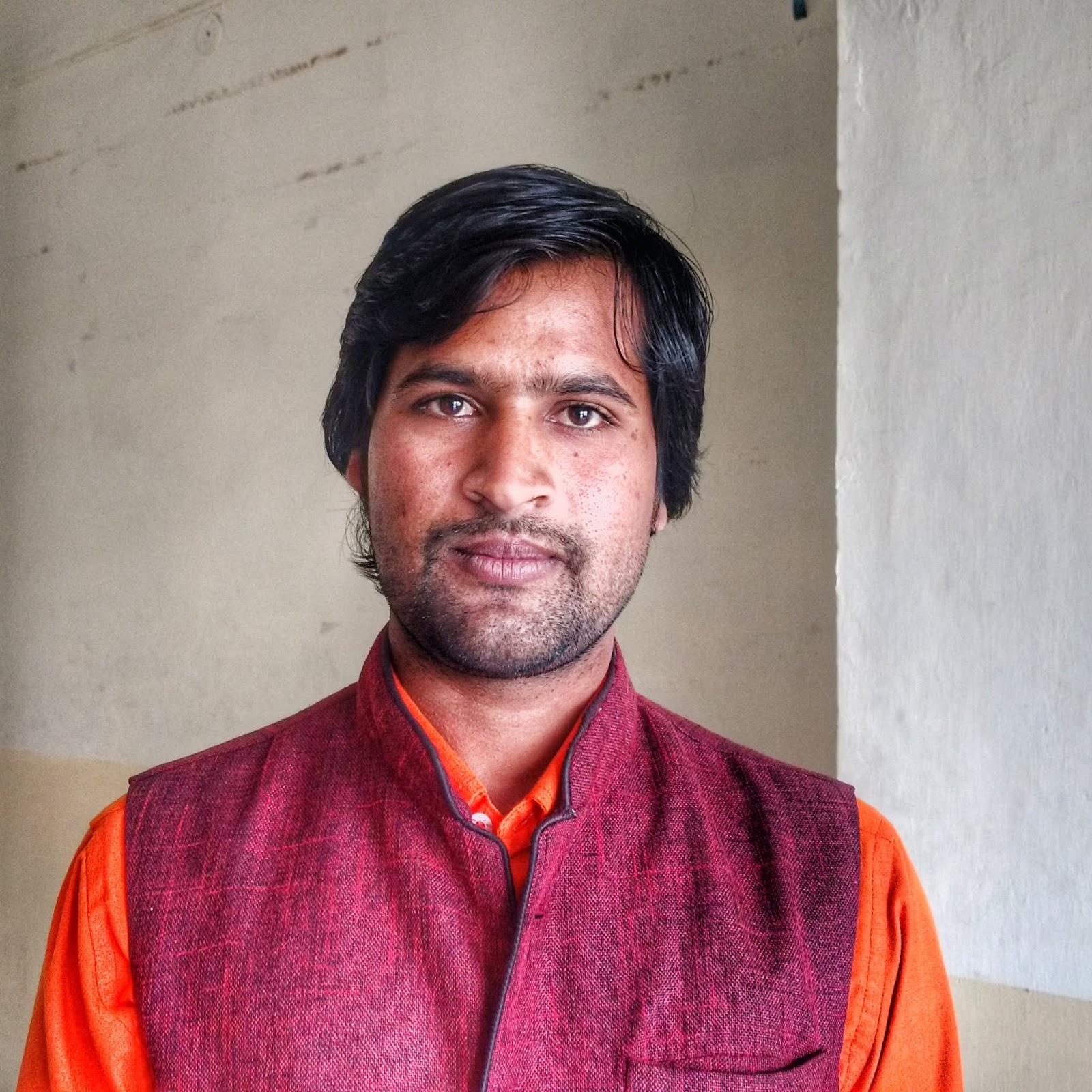
Monday, May 20, 2013

The women of Pratham Series: Pushpa Mauri

                                                   By Pia Brar

Pushpa Mauria has been working with Pratham since 2004. She is from the Jaunpur District in the Varanasi Division of Uttar Pradesh, where she first experienced Pratham’s influence on a community. Mauria explained that she heard of the organization from the eleven people of her village that were already involved with Pratham. The work they were doing interested her, but she did not yet feel the drive to become involved herself.


“Initially I did not see the point of teaching with no salary, and so I stayed home,” she said. “But after
talking to some people I understood how significantly volunteering my time could help children’s learning.”

Mauria began her work with Pratham by gathering a group of twenty-five students from her village and surrounding areas with the aim to improve their reading levels. Mauria worked with these children for a month and fifteen days and was able to bring fifteen out of the twenty-five children up to the “Reader Level”,
 enabling them to read full paragraphs with fluidity and understanding.

Because of her dedication to her work, Mauria has had the opportunity to work in and travel to
multiple districts in Uttar Pradesh over the years.

“Though I may receive a small pay check, I value working at Pratham” she said. “I have been able to
travel to various places for work and training, which I would not  have had the chance to do otherwise, and
I’ve had the opportunity to meet many important people, especially government officials.
I got to speak with them... and they would listen.”

Mauria is now currently working in Dadri, Uttar Pradesh, where she has been promoted as the leader
of Block Resource Group of the area and oversees the training for and the evaluation of projects in Dadri. However, she is known for her ability to mobilize a community.

“I go into the villages and speak to the parents. We hold meetings where we use the Read India
testing tool to show the parents which learning level their children are at compared to where they
should be. By doing this we demonstrate how effectively Pratham can help,” she said.

Upon reflection of the near decade Mauria has spent with Pratham, she states, “I can now lead meeting
 and to speak to large audiences, I have the courage to teach in a classroom. My work has expanded
my frame of mind and helped me understand larger issues faced by a society.” 


Monday, May 13, 2013

Second Chance: Educating Girl Dropouts in India’s Remote Corners


                                              By Sarita Gupta

255 girls from Odisha who had dropped out of school completed their 10th standard education after nine months of remedial training and sat for their board exams. The results came out last week: 158 of them (62%) passed, with one even coming in the first division.

This is not big news in a country the size of India, and the only ones celebrating aside from the girls and their families was a small team gathered around a conference table at the headquarters of Pratham. I happened to be visiting a similar batch of girls in Chhattisgarh a day earlier, who will be taking their exams in mid-May. Here is what I saw of their determination and the barriers they are overcoming to get what most of us think of as our birthright and take completely for granted.

I grew up with a daily reminder that being born a girl in India in the early 20th century could be a raw deal. My grandmother lived with us and she was illiterate. Her parents were not poor, they simply saw no reason to educate their daughter. My grandmother was married at 13 and widowed at 25. which consigned her and her two children to a life of utter dependence on her in-laws. Transported to the US when her son (my father)moved there, she lived in a cocoon, secure in the family bosom but in a narrow world where her considerable intelligence was wasted on chewing over the family gossip and magnifying every slight.

It is still not easy for a girl to be educated and make her own life choices in today’s India, even as the country has gained wealth and power unimaginable to my grandmother’s generation. Leave aside issues of safety or employability where huge gender gaps exist. Even in something as gender neutral as educating the nation’s children, girls lag: only 40 Indian girls out of every 100 that begin primary school will complete 8th grade.  This number, shocking as it is, masks even bigger gaps between urban and rural, and between middle and lower income families.

The reasons for dropping out of school are many and complex—one study cites 20 of them—but the end result is the same. An uneducated child faces a bleak future. The girls and women I met in Chhattisgarh had heartrending reasons for dropping out. Several did so to get married. Two lost their fathers and had to start earning a living to support the family. Yet all of them had made the decision to come back and finish 10th grade.

They did not make this decision by themselves. There was a small army of people pushing them forward. In the vanguard of this army is the Pratham community organizers, who go door-to-door to survey who is in school and if not, why not. When they find an older girl or woman dropout, they spend considerable time convincing them and their families to enroll in a nine-month program which includes daily study with an instructor in the village plus a monthly stay at a residential camp. The families have to commit to handling the girls’ chores while they go away for five days every month.

The camp has an administrator and three faculty members to provide instruction in Hindi, English and math. There is another group at Pratham headquarters that has taken apart the standard curriculum, applied “western” pedagogical methods to it, and painstakingly created new teaching and learning materials.

I ask the girls in Chhattisgarh what they plan to do after they graduate. Silence. Except for two government workers who need to pass 10th grade in order to be eligible for promotion, the rest have not dared to dream of an altered future.

My father, born to an illiterate mother, planned to drop out of school when he was 13 so that he could help out in the family business. The only one against this plan was an uncle who somehow saw his potential and moved heaven and earth to get him educated. My father in turn made sure that no effort or expense was spared to educate his four daughters, all of whom went to Ivy League universities in the US, and became financially independent. In two generations my family was able to rewrite the destiny for its girls. It will happen to you too, I tell the Chhattisgarh girls.

This is the drive behind Pratham and what motivates its 2,000 staff and 60,000 volunteers: the chance to recreate a new India in which every child has learnt well and has the means to become a productive, prosperous citizen. The 255 girls from Odisha are proof it can be done. Chhattisgarh will be close behind.

Sarita Gupta is founder and president of Indico, International Nonprofit Development Consultants. She recently began working with Pratham USA.


Monday, May 6, 2013

The Women of Pratham Series: Poonam Sandhu

By Pia Brar, Intern


Poonam Sandhu has been working with Pratham since
 2003 and is now the “Head coordinator” 
for Pratham’s centre in Dadri, Uttar Pradesh.

Poonam became a volunteer at a small mandir 
school her village.

“I always wanted to support the children who came from troubled households, 
who didn’t go to school, or so wondered on the streets,” she said.

During her time at the school, she began to realize that the teaching methods 
were not engaging enough and the students were not learning well. Poonam 
then heard about the classes Pratham operated and soon visited the centre
 to witness the innovative teaching methods she had been hearing about.

“By seeing the Pratham classes, I was keen to work and asked the teacher 
how to get involved. She helped me contact Pratham and I have committed to 
my work ever since,” she said.

Poonam was promoted and transferred from her village to the more urban setting 
of Dadri, leaving her own two children behind. “Initially this was extremely hard,
” she said, “but I realized my children have their grandparents to watch over, 
a good home and good schools, but what about the other children? 
The ones who have none of these? Those are the ones I really need
 to help and that’s why I do what I do.”

For the past decade, Poonam has dedicated her time to Pratham and to her
 young students. She spends her days organising ten-day Learning Camps to be run 
in the government schools of Dadri, teaching in the camps and ensuring that the 
Read India program is implemented effectively in her area.

Poonam’s driving force is something close to her heart. “I strongly believe girls should 
have the opportunity to be educated,” she stated. ”Luckily, I had that opportunity, 
and I’m a girl, but every girl should have this right. In India, it is important to
 help the parents understand this, so that is what I am fighting for.” 

Thursday, March 28, 2013

Chattisgarh Education Programs

Chattisgarh: Living On Hope 
By Chandrika Rathore

Ever since I started work at Pratham, which was almost six months ago, I’ve been particularly keen to visit its education programs in Chhattisgarh – the small state in Central India that was born out of Madhya Pradesh. Its people, after all, have long had to endure the struggle between the government and the Naxals and I was eager to see how these programs would run amidst such menace.
Prior to my visit, the only ideas I had about the socio political affairs of the state were from what I had read and heard. Based on that limited information, I had formed strong biases (best left undeclared) that came out in the endless debates I had with friends and acquaintances.
Hence I looked forward to a visit hoping to better understand the situation in the state. In retrospect, I think I had been little naive to believe that this short visit would all so simply wipe away my doubts and bring me back with a crystal clear viewpoint.
What I did come back with, however, was a rather pleasant perspective, even if not with answers to all my questions; and the realization that this was enough for the time being. It would be wrong, maybe even unfair to believe in the possibility of understanding a situation of this nature in such little time, with such little interaction with the people there. It would be an insult to the atrocities the common man has faced in Chattisgarh and most of all, it was impossible.
During my four-day visit, I had several questions and fortunately, I had for company, a colleague from Mumbai who was revisiting with me, Swamiji - the Unicef program head and Papuji who tirelessly drove us around, through unfriendly terrains. They were knowledgeable about the affairs of their state. I wanted to know their views for they would also, in some way or the other, reflect the views of people they knew: who did the people of Chhattisgarh sympathize with? But as is the case with most things, nothing was black and white. Even so, while Swamiji came forward in his support for the government, Papuji was quick to establish that he disagreed.


Thursday, March 7, 2013

Repost of Article From 'The Hindu'


Educating 'Nirbhayas'...Whose 'Karthavya'?  

Vinay Sankar


A lost childhood, a run-away mother, a broken marriage, a 13 year old son and an elderly father to take care of -- none of these deterred Jaya Rawal from continuing her education. Jaya’s voter id shows she was born in the year 1979 and yet, she says she is not sure of her real age. In her fragile physique, she conceals a dogged determination to continue her studies and to get ahead. 

It is said, 'when the going gets tough, the tough gets going' and that is absolutely correct in the case of Jaya. When the mother left her in her early teens, Jaya had to take charge of the family. That meant she discontinue her studies and take care of her siblings. Her father was with the Telecom Department, but, due to lack of a minimum period of service, is not eligible for a pension. Presently, she does nearly four-five hours of tailoring every day, earning around Rs. 3000 per month, to meet her family's needs. She hardly gets to eat three rotis a day! 

In spite of all these and more, she wakes up at four in the morning and studies for three hours, and in the evening, she is with books for another three hours till midnight, in order to pass her Secondary School exams under the Rajasthan State Open School (RSOS) Board.

Now, imagine two friends. They were studying together in the same class at the Secondary School in 2006. Fast forward to 2012. One of them became a teacher, while the other one became..guess what, her student! This might sound filmy, but it did happen to Jayashree Khairvasiya and Deepika Vyas. While Jayashree is a tutor, Deepika is her student. Deepika could not clear her ninth grade exams and thereafter, she discontinued her studies. Mean while, Jayashree continued her studies and she is now in her final year of graduation, where her main subject is astrology. Unfortunately for Deepika, stars did not smile at her. But, she is quite determined that she would clear her secondary school exams this year through RSOS.