Thursday, August 12, 2010

I came, I taught

11:16:00 AM

I came, I taught

By Dhwani Jain

The last three weeks spent at the Pratham School at Kadipur, Gurgaon were the most gratifying and eventful of my life. Here Pratham tests the government school students for their English and Hindi capabilities and the weak ones are enrolled into the Pratham class where Pratham teachers work on them. I got an opportunity to teach English to children from class 3, 4 and 5 who were lacking in the language.

Thursday, May 13, 2010

VOICE of the VOICELESS:

12:30:00 PM
“Our greatest inheritance is our democracy and the freedom of expression it gives us. Indeed, often those who are loud are better organized, better funded, and better served by the system. If the media only purveys their viewpoint, who will speak for the silent majorities?
One organization that does work for the upliftment of the silent majority is Pratham.”
- Dr. Manmohan Singh, Prime Minister of India - At the CNN IBN Indian of the Year 2009 award function.

Speech is God's gift to mankind. Through speech a human being conveys his thoughts, sentiments and feeling to others. Freedom of speech and expression is thus a birth right. Article 19(1)(a) of Indian Constitution legitimizes the right to freedom of speech and expression of all Indian Citizens.
However as our honorable PM rightly pointed out there is a vast majority which is “silent”. Children comprise of a large portion of the “silent” majority. No one listens to them as they do not comprise of a lucrative vote bank.
11 year old Murli, living in Yazali village in the Guntur district of Andhra Pradesh is one of the members of this “silent” majority. Not only due as to the lack of muscle or money power, but also because he is speech impaired.

Wednesday, April 7, 2010

Picture Story: A trip to Orissa

3:50:00 PM
Recently I made my trip to Orissa that was long overdue. I want to share with you the interesting things I saw and learnt....from children, teachers, villagers and sometimes complete strangers. We left from Cuttuck city at about 11 am to go to Khurda district which was 3 and a half hours away. We crosses a huge river or rather what was left of it....(this was in the winter months...wonder what it is like in the summers)

Our first visit was at a village where the class was already in session. Seeing us in the classroom, the parents came to talk to us. The man on the far left is the Sarpanch of the village.
Reality check: The lady told me in Odiya “I know in the city you need to press a button and the water comes gushing out. Do you find what I’m doing fascinating?”
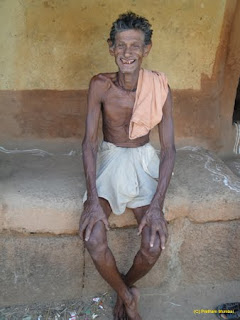
He refused to smile for the camera. However when he finally agreed, this is what he gave me.
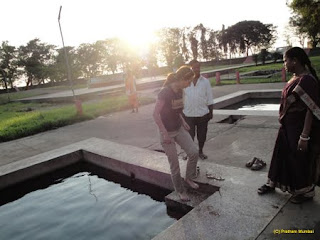
Fun Along the Way: The Pratham team and I stopped by a hot spring which is now a picnic spot on our way to another village.
Nearing Dusk: It was almost sundown by the time we reached our second last stop of the day. A child learning how to count using the Bandal tilli method.
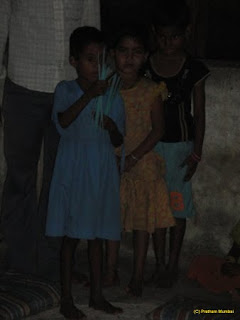
Our last stop of the day: In a village where the volunteers have made two groups; one with the older children in Std 3,4,5 and the other group with younger children from Std 1 and 2.
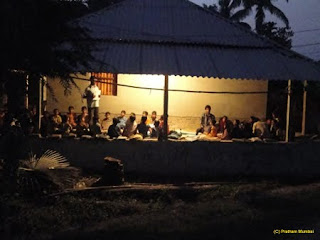
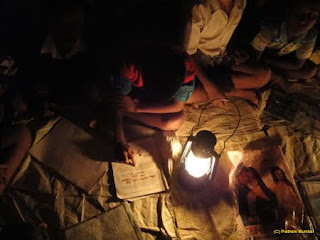
The Spirit of Pratham: In the same village, soon after we arrived, there was a power cut. In a matter of minutes, the lantern were removed and the class continued.
This is when you realize…. You are part of something very big.
By Anamara Baig: Mumbai

Friday, February 26, 2010

On Road: Stories by Olivia Toye (concluding part)

12:04:00 PM
Bangalore


I reunited with Jen in West Bengal. There, we spent a week volunteering at the Mother Teresa Home for mentally disabled women, teaching college graduates English and interview skills in Kolkata, trekking on the Nepali border and of course, tasting tea in Darjeeling. We flew from Communist Kolkata (where the jute workers, encouraged by the CPM government, have been on an indefinite strike since the 14th December) to ultra modern Bangalore, the pinnacle of India’s booming IT industry. The silicon-coated heart of India was immediately present from the shuttle-bus airport transfer. Here, Infosys, the Indian IT giant has its HQ. Established less than 20 years ago, today the company has over 100,000 employees and revenues of US$4bn. Its clients currently include nearly 100 Fortune 500 companies. Its 32-hectare campus (which we passed but unfortunately failed the stringent security checks to have a snoop around!) comprises of shiny glass and steel structures sprouting from perfectly manicured lawns.

Despite this glimpse of an alternative India, the wealth has not spread throughout Bangalore, or indeed, Karnataka, the state in which it lies. 62% of Bangalore’s population are ‘Indo-nationals’, meaning they originate from other Indian states as far as Punjab, Rajasthan and Assam. The majority of them who fill the vacancies at Tata Consultancy, Goldman Sachs, Intel and the likes are India’s privileged few who have been to private schools and one of India’s up-and-coming universities (at a fee). From the young professionals we spoke to, it appears only a limited list of science-based degrees, such as Engineering and Computer Science, hold any value in India. A reflection of this system is portrayed eloquently in the recent hit Bollywood movie, ‘The 3 Idiots’. As Arindam Chaudhuri, editor in chief of Planman Media comments, “the film has a strong message to the many idiots running the education system of this country and to the millions of idiots who accept this system without questioning.” Fact is, many able arts candidates are paralysed by the lack of job prospects open to them when they graduate and are instead forced to study engineering or computer science. The drop-out rate is not high, but the student suicide rate is.

In Bangalore, Pratham has been working in collaboration with the Akshara Foundation (www.aksharafoundation.org) since 2000. In Pratham’s office in the Bangalore suburbs, Ashok, the well-spoken Chairperson showed us the impressive database (www.klp.org.in) by which they track 725,000 children across Karnataka. The aim is to quadruple that number by the end of this year and to reach 13 million in 3 years time. The Pratham-Akshara interventions are 60 sessions long in, for example, Kanada (the state’s first language), Urdu, Maths and English, over 3 to 5 months. Each child is tested at the beginning and end of the programme to monitor their progress. Pratham-Akshara don’t just work in Bangalore but across Karnataka and particularly in the North, in areas like Bidar and Gulbarga which have much lower HDI ratings and are mainly dependent on agriculture.
In the afternoon Tasmiya, who is in charge of Shivnagar district, took us to visit a government Urdu higher primary school in Frager town. On the bumpy rickshaw ride through Bangalore, she told us how over the last 10 years she’s seen the Pratham-Akshara collaboration grow from serving just 20 school drop-outs between 7-14 years old to over 350,000 children in Bangalore today. At the Muslim school we met the librarians who showed us the impressive collection of Urdu (the first language in Muslim families), Kanada (the first language in Karnataka), Hindi (supposedly the national language, though this is contested down south), Tamil (spoken to the East in Tamil Nadu), Telugu (to the North in Andhra Pradesh) and English. The boys in the class were extremely enthusiastic to read us English stories, particularly one eager boy named Asif. His father was a rickshaw driver although he had aspirations to study Engineering and work for one of the proliferation of high-tech companies, like Infosys. Ten years ago, this dream would have been just that. Today, with Pratham’s extra tuition and English language materials, the son of a rickshaw driver’s dream, like many of his classmates, can indeed become a reality.

From here Jen and I made our way to Gokarna to spend a few days at the coast before returning to hectic London. It’s been an absolutely thrilling journey, travelling around India with Pratham and experiencing a diverse and genuine flavour of India. We’d like to thank everyone that’s made it possible for us to have this incredible experience – all of the Pratham coordinators and the team back in Mumbai, especially Anamara. Thank you and Namaste!
By Olivia Toye (UK)

Monday, February 22, 2010

On Road: Stories by Olivia Toye (8)

12:04:00 PM
Assam – 2nd Feb


When asked what my travel arrangements were for this evening I received an applause of laughter when I mentioned I was taking the 10.30 overnight Kanchanjung Express train. ‘What’s the problem?’ I enquired. ‘Oh that train was held up the other night in Kokrajhar. No probs though, sure it’ll run fine tonight!’ It appears it’s not just the northern oil-producing area around Digboi where the kidnappings happen. Apparently there’s also trouble to the east, on the Bhutan border, where there’s ‘just some people on the independence bandwagon’ according to Abhijit, the witty well-educated political scientist of the office.


The Assamese state symbol is the Rhino. Abhijit mused that the Rhino’s slow pace suits the Assamese attitude to life but this description certainly wasn’t fitting with Surjya’s programme for me for the day! We began at 7am. The car was packed with Surjya (the DRC head), Tapashi, (smart working Mum for the joint Pratham-ASER survey), Mukut (Kamrup district coordinator), Abdul (the mad driver) and me (the eager English girl). We left Guwahati for Hajo, a small town 35km away where we visited 2 Pratham Learning Centres (PLCs). 120 children from the 1st to 5th Standard (6 to 11 years) attend classes at the 2 centres before school from 8 – 9.45am. Next we visited Suwal Kucha, nicknamed ‘Silk City’ by Mukut (despite the fact it was more of a village), where the PLC runs weekend classes. In this area silk weaving is the major employer – and indeed the main occupation of the Pratham volunteers here – so a visit to a silk factory seemed fitting.

Back in the car we drove at the pace of Abdul’s Indian techno music to Darang, 15km from Bhutan. Passing tea plantations on the way we crossed a loud All Assamese Students Union (AASU) protest. A large concern in this district is the rising food and commodity prices which severely hurt local people working in the plantations, on very minimal weekly salaries. On arrival at the government school that Pratham works in association with, I was able to meet 8 volunteers from the neighbouring villages. Sitting on the grass in the playground, I asked them what their greatest challenge had been. They were unanimous in their opinion that terrorism though it is often used, is not a good enough excuse for poor education in the state. Rather the socio-economic issues – such as alcoholism in poor communities – is disabling their efforts.


After some fantastic Assamese tea at Mukut’s family house, we began the 100km drive back to Guwahati. I began pondering everything I’d learnt. Despite such large challenges – from political to socio-economic – nothing deters Pratham’s reach to the most beautiful region of India I’ve visited so far. I thoroughly recommend a visit!
By Olivia Toye (UK)

INSTA FEED

Pratham Education Foundation

Pratham India is the official blog of non-for-profit organization Pratham Education Foundation showcasing exciting stories throughout India.

Follow

 Follow us on Twitter!   Follow us on facebook!   Follow us on instagram!   Follow us on Youtube!